
&imwidth=800&imheight=600&format=webp&quality=medium "Can Alberta break away from Canada? Referendum plan and laws explained | WION Decodes")
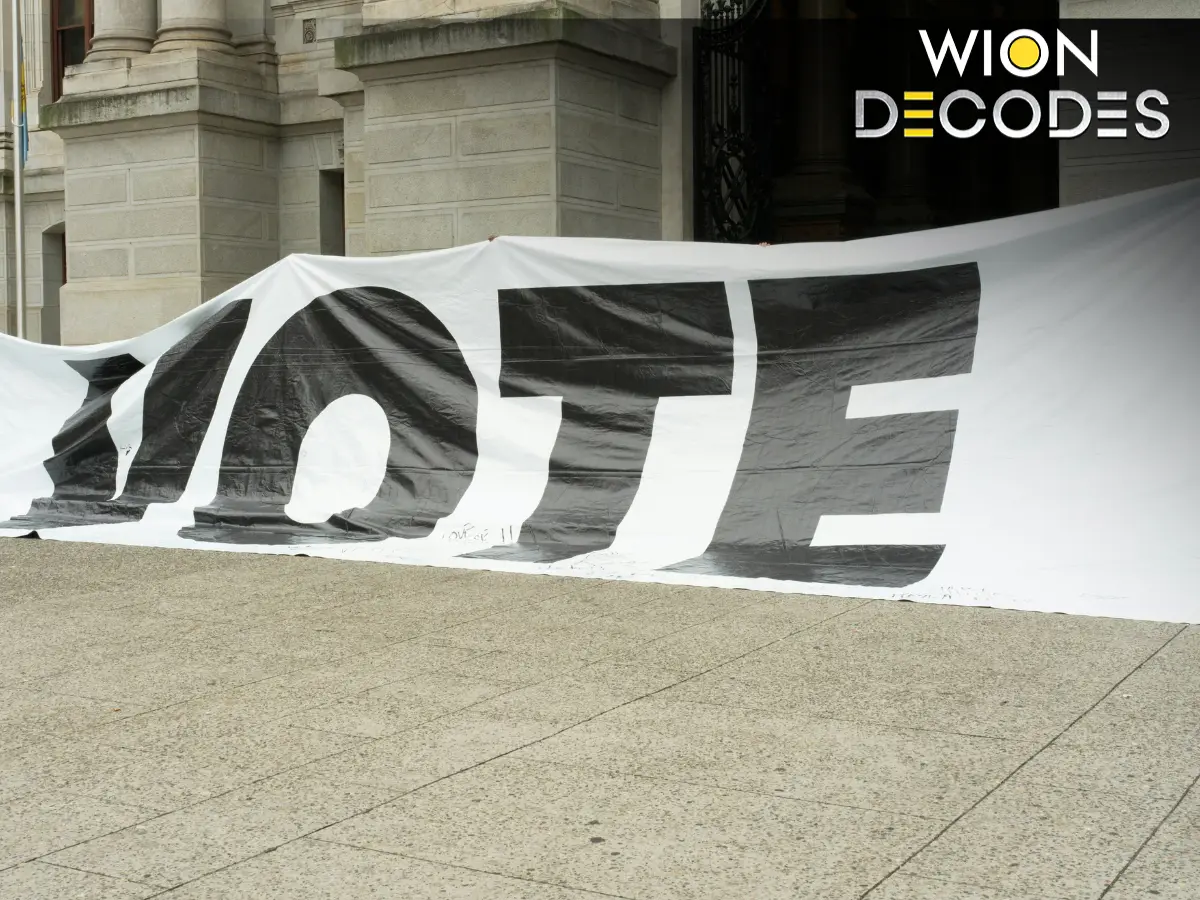
Canada's Alberta province will conduct a referendum in October this year to ask its citizens whether they want to remain a part of the country or seek independence. This marks a major test for Mark Carney led country in decades as it is being touted as Canada's Brexit moment. Alberta's leader, Premier Danielle Smith, announced the coming vote this week and batted for a unified Canada. Alberta, the oil-rich province of Canada has been harbouring separatist sentiment in past few years and the recent referendum call was triggered after 300,000 people signed a petition asking that a vote be held on the matter. According to reports, Albertans will be asked: “Should Alberta remain a province of Canada or should the Government of Alberta commence the legal process required under the Canadian Constitution to hold a binding provincial referendum on whether or not Alberta should separate from Canada?” Voters will have a choice of checking two boxes — option A being to remain in Canada and option B being to commence the legal process to hold a binding separation referendum. The referendum will have a five-month campaign period.
Why it is happening

There are separatist groups in Alberta who are pushing for country's independence from Canada. Though, the petition signed by 30000 people was blocked by an Alberta court earlier this month, another group led by a former deputy premier of Alberta, Thomas Lukaszuk, collected more than 400,000 signatures for an anti-separation petition called Forever Canadian. This is happening in a province with nearly five million population. The separatist movement is led by Mitch Sylvestre, a gun shop owner from the town of Bonnyville, and Jeffrey Rath, a lawyer based in Calgary. Both Sylvestre and Rath are members of a group called the Alberta Prosperity Project, which argues that the province's economic growth has been hindered by years of Liberal party rule in Ottawa. BBC reported that people joining the movement are fed up of environmental policies that comes in way of resources from the oil-rich province. The separatist sentiment is driven by “western alienation” — a long-standing belief among many in western Canada that federal leaders in Ottawa ignore and underrepresent their interests, though its demands are not uniform.
What does Canadian law say about separation?
Trending Stories
)
JP Nadda, Jitendra Singh meet Sonam Wangchuk at Medanta Hospital: Report
)
Trump announces 200% tariff on generic drugs: Here's what it means for 'Pharmacy of the World' India
&im=FitAndFill=(700,400))
Meet top 5 batters with most runs in India vs Zimbabwe T20Is
)
'Is that a back-up Trump?' Mysterious look-alike standing behind Donald Trump baffles netizens
)
US-Iran war cost hits $37.5 billion as Hegseth seeks $67 billion more for Pentagon
)
Sonam Wangchuk's connection with George Soros and Ford Foundation explained!
)
UP BTech gold medalist dies by suicide after failing in nearly 50 govt job attempts, leaves note for father
)
Salman Khan breaks silence on health concerns after viral Mumbai appearance
)
'George Soros playbook': Understanding the foreign funding network around Sonam Wangchuk
&im=FitAndFill=(700,400))
New OTT releases this week (July 20-26, 2026): Musafir Cafe, Adarsh Baal Vidyalaya, 72 Hours- 5 new titles coming on Netflix, Prime Video and more
&im=FitAndFill=(700,400))
2026 FIFA World Cup awards: Full list of Golden Boot, Golden Ball, Golden Glove and every major winner
)
Is Pentagon hiding missile shortage from Trump? US officials raise alarm over Iran war readiness
)
'Criticising him after two or three matches isn't justified': Sikandar Raza backs Vaibhav Sooryavanshi
)
'We acted immediately...': Indian PM Modi breaks silence on paper leaks as NEET protest, calls for Education Minister's resignation grows
)
Kaylee Hottle was unconscious: Shocking details from first responders revealed after teen star's death
)
'What is wrong...': Anna Hazare breaks silence on Sonam Wangchuk's protest, makes an appeal to Centre
)
FIFA 2026 | 'I am truly sorry': Argentina's Enzo Fernandez, who get red card in final, reacts to loss
&im=FitAndFill=(700,400))
Why US fighter jets use seamless bubble canopies compared to Russian jets
&im=FitAndFill=(700,400))
Why the F-22’s cockpit glass is thicker than a standard fighter jet
)
Student union leaders call off hunger strike at Jantar Mantar after civil society appeal, but protest continues
)
‘He's the architect of the genocide against Palestinians’: Mamdani repeats Netanyahu will be arrested if he visits US
&im=FitAndFill=(700,400))
World's top 7 most liveable cities in 2026 — Check where India and Pakistan stand
)
'Guru is the...': Indian Education Minister Dharmendra Pradhan shares message on education amid calls for his resignation
)
'Not permitted ...': IIT Roorkee issues gag order as students' protest intensifies
)
'Don't waste...': CJI Surya Kant breaks silence on Delhi police brutality against protesting students
)
'This should not happen in a democracy': Shashi Tharoor slams detention of Rahul Gandhi, Priyanka Gandhi after protest outside PM Modi's residence
)
FBI arrests alleged $547mn medicare fraud fugitive after 3-year global manhunt
Canada’s laws do not allow a province to simply leave the country on its own. The legal framework was created after Quebec’s narrow 1995 independence referendum, when the federal government asked the Supreme Court to clarify whether a province could legally separate from Canada. In 1998, the Supreme Court ruled that a province cannot unilaterally secede. However, it said that if a province held a referendum with a “clear question” on separation and received a “clear majority” in favour, then the federal government would be obligated to negotiate. Following that ruling, Canada passed the Clarity Act, which formally laid out the process for any future separation attempt.
What is the Clarity Act?
The Clarity Act gives Canada’s House of Commons the authority to decide whether:
- the referendum question is “clear” enough, and
- the result represents a “clear majority” in favour of separation.
The law does not define an exact percentage for what counts as a clear majority. While some argue that 50 per cent plus one vote should be enough, others — including former minister Stéphane Dion, who drafted the law — say a simple majority may not be sufficient for something as significant as breaking up the country. The Supreme Court also said separation would require negotiations between the federal government and the province seeking independence. Other provinces would likely have to be involved too because secession would affect Canada’s Constitution, economy, borders, resources and political system.
Why would constitutional changes be needed?
Canada’s Constitution does not contain a direct process for a province to leave the federation. That means any separation would require constitutional amendments approved through a broader national process involving provincial legislatures and Ottawa. Legal experts say the impact of one province leaving Canada would affect every other province, making nationwide negotiations unavoidable. Bernard Funston, who participated in the 1998 Supreme Court reference case, was quoted in reports saying that the consequences for the rest of Canada would be “astounding” because separation would impact everything from federal representation to resource sharing and national institutions.

