
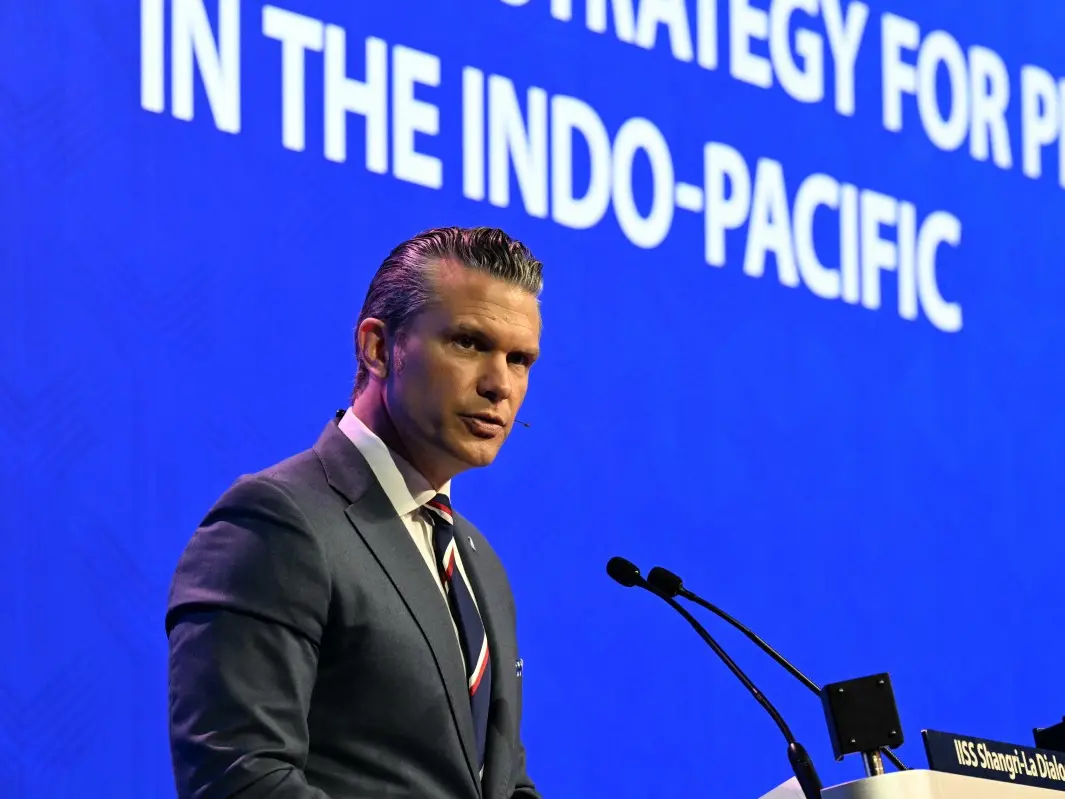
&imwidth=800&imheight=600&format=webp&quality=medium "Hegseth at Shangri-La Dialogue warns China's military build-up causing 'alarm' across Asia, says US seeking 'stable equilibrium'")
US Defence Secretary Pete Hegseth on Saturday (May 30) warned that China's rapidly expanding military capabilities are generating a "rightful alarm" across the Indo-Pacific, as Washington renewed its commitment to maintaining a balance of power in the region where no state has unchecked power.
Also read | US 'more than capable' of restarting war with Iran, says Hegseth amid reports of depleted missile stockpiles
Indo-Pacific nations 'alarmed' over China's rise

Speaking at the Shangri-La Dialogue in Singapore, Asia's premier security forum, Hegseth said countries across the region were increasingly worried about Beijing's military expansion and its growing strategic footprint.
"When we look across the region today, there is rightful alarm regarding China's historic military build-up and the expansion of its military activities in the region and beyond," Hegseth said during his keynote address.
His remarks come at a time of heightened tensions between Washington and Beijing over Taiwan, maritime disputes in the South China Sea and competition for influence across the Indo-Pacific.
Trending Stories
Despite the sharp criticism, Hegseth insisted the United States was not seeking confrontation with China. US does not seek "needless confrontation in the region," he told delegates, which included defence ministers, military officials and security experts from around 45 countries.
Instead, the Pentagon chief said the US objective was to preserve stability by ensuring that no single country dominates the region.
Also read | Watch: Blue Origin’s New Glenn rocket explodes in massive fireball during launch pad 'hotfire test'
If not confrontation, what does the US want?
According to Hegseth, Washington is working towards what he described as a "genuinely stable equilibrium" that benefits both the United States and its allies.
He said this means maintaining "a favourable but durable balance of power in which no state, including China, can impose its hegemony and hold the security or prosperity of our nation and our allies in question."
The comments reflect growing concern in Washington over China's military modernisation programme, which has seen Beijing rapidly expand its naval fleet, missile arsenal and air power over the past decade.

