Data Lab | Putin’s nuclear threats: What happens if Russia uses nukes?


Putin’s nuclear threats: What happens if Russia uses nukes?
The potential of a nuclear 'Armageddon'is at its greatest point in 60 years, UnitedStates President Joe Biden has warned as the Ukraine war drags on. A scenario in which nuclear weapons resulted in global annihilation is known as a nuclear 'Armageddon',also known as a 'nuclear holocaust.'
Nuclear weapons are considered weapons of mass destruction because they have the potential to produce significant radioactive effects. Only twice in history have nuclear weapons been used in actual combat, and both times were in 1945 when the US dropped atomic bombs on Hiroshima and Nagasaki to finish the Second World War.
As Russia asserted it would employ "all means" at its disposal to defend its borders, Biden claimed that Russian President Vladimir Putin was "not joking." A "precedent" was set by the US utilising nuclear weapons during World War Two, according to Putin.

Analysts, however, contend that rather than indicating a desire to deploy nuclear weapons, Putin's remarks should most likely be taken as a warning to other nations not to intensify their participation in Ukraine.
How many nuclear weapons does Russia possess?
The number of nuclear warheads in Russia is 5,977, according to the Federation of American Scientists, albeit this number includes roughly 1,500 that are decommissioned and scheduled for decommissioning. All nuclear weapon numbers are estimations.
)
JP Nadda, Jitendra Singh meet Sonam Wangchuk at Medanta Hospital: Report
)
Trump announces 200% tariff on generic drugs: Here's what it means for 'Pharmacy of the World' India
&im=FitAndFill=(700,400))
Meet top 5 batters with most runs in India vs Zimbabwe T20Is
)
'Is that a back-up Trump?' Mysterious look-alike standing behind Donald Trump baffles netizens
)
US-Iran war cost hits $37.5 billion as Hegseth seeks $67 billion more for Pentagon
)
Sonam Wangchuk's connection with George Soros and Ford Foundation explained!
)
UP BTech gold medalist dies by suicide after failing in nearly 50 govt job attempts, leaves note for father
)
Salman Khan breaks silence on health concerns after viral Mumbai appearance
)
'George Soros playbook': Understanding the foreign funding network around Sonam Wangchuk
&im=FitAndFill=(700,400))
New OTT releases this week (July 20-26, 2026): Musafir Cafe, Adarsh Baal Vidyalaya, 72 Hours- 5 new titles coming on Netflix, Prime Video and more
&im=FitAndFill=(700,400))
2026 FIFA World Cup awards: Full list of Golden Boot, Golden Ball, Golden Glove and every major winner
)
Is Pentagon hiding missile shortage from Trump? US officials raise alarm over Iran war readiness
)
'Criticising him after two or three matches isn't justified': Sikandar Raza backs Vaibhav Sooryavanshi
)
'We acted immediately...': Indian PM Modi breaks silence on paper leaks as NEET protest, calls for Education Minister's resignation grows
)
Kaylee Hottle was unconscious: Shocking details from first responders revealed after teen star's death
)
'What is wrong...': Anna Hazare breaks silence on Sonam Wangchuk's protest, makes an appeal to Centre
)
FIFA 2026 | 'I am truly sorry': Argentina's Enzo Fernandez, who get red card in final, reacts to loss
&im=FitAndFill=(700,400))
Why US fighter jets use seamless bubble canopies compared to Russian jets
&im=FitAndFill=(700,400))
Why the F-22’s cockpit glass is thicker than a standard fighter jet
)
Student union leaders call off hunger strike at Jantar Mantar after civil society appeal, but protest continues
)
‘He's the architect of the genocide against Palestinians’: Mamdani repeats Netanyahu will be arrested if he visits US
&im=FitAndFill=(700,400))
World's top 7 most liveable cities in 2026 — Check where India and Pakistan stand
)
'Guru is the...': Indian Education Minister Dharmendra Pradhan shares message on education amid calls for his resignation
)
'Not permitted ...': IIT Roorkee issues gag order as students' protest intensifies
)
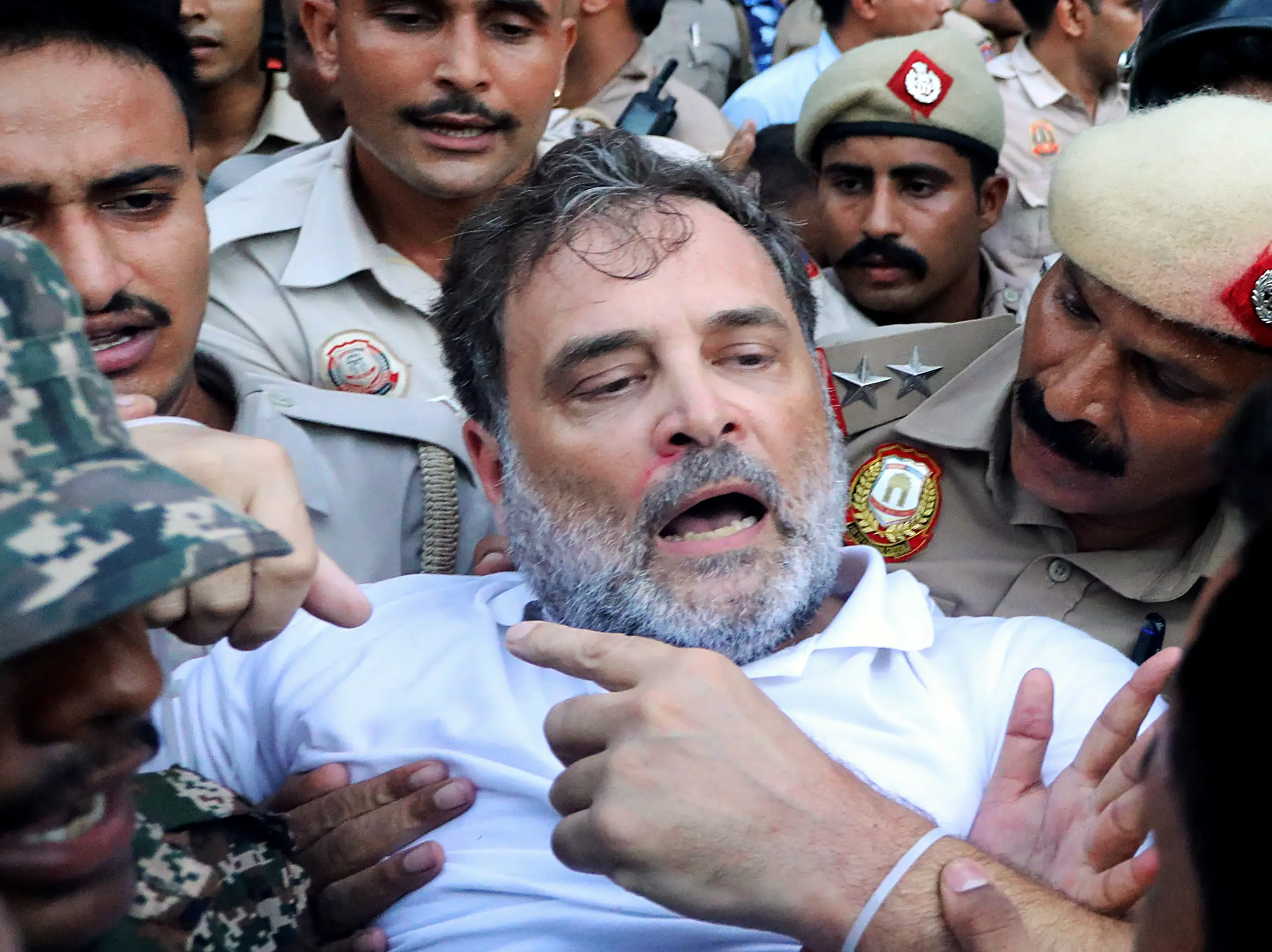
'Don't waste...': CJI Surya Kant breaks silence on Delhi police brutality against protesting students
)
'This should not happen in a democracy': Shashi Tharoor slams detention of Rahul Gandhi, Priyanka Gandhi after protest outside PM Modi's residence
)
FBI arrests alleged $547mn medicare fraud fugitive after 3-year global manhunt
The majority of the 4,500 or so surviving nuclear weapons—ballistic missiles or rockets with long-range targeting capabilities—are regarded as strategic nuclear weapons. These are the weapons that nuclear war is typically linked to.
The remaining nuclear weapons are smaller and less lethal and are intended for close-range combat on land or at sea. But this does not imply that Russia is prepared with thousands of long-range nuclear weapons.
Global comparison
Nine nations possess nuclear weapons: China, France, India, Israel (though not publicly acknowledged), North Korea, Pakistan, Russia, the US, and the UK.
According to experts, 1,500 Russian warheads are currently "deployed," that is, located at missile launchers. The Treaty on the Non-Proliferation of Nuclear Weapons (NPT) has 191 signatories, including China, France, Russia, the US, and the UK.
As perthe agreement, they are required to decrease their arsenal of nuclear warheads and, in theory, are devoted to completely eliminating them.
Additionally, it has decreased the number of warheads kept in those nations since the 1970s and 1980s.
India, Israel, and Pakistan did not sign the NPT, and North Korea withdrew in 2003. Despite having nuclear warheads, Israel is the only one of the nine nations to have never openly admitted having a nuclear programme. There is no proof that Ukraine has tried to acquire nuclear weapons, despite President Putin's alleged threats.
What happens if Putin actually uses nuclear weapons?
According to Dr Manisha Chaurasiya, Assistant Professor, Department of Political Science, Lady Shri Ram College for Women, Delhi University, even in the worst case scenario, wherein Russia actually uses nuclear weapons (which is highly unlikely), it would face not just international condemnation and sanctions,but something much greater than that.
“This would lead to a 'legitimate' response from the international community which would be not anything less than military action. That would be the last thing that Putin would want and Moscow has well in advance warned Western Europe and the United States to not intervene in the Ukraine war,” she adds.
“Putin’s threats to use nuclear weapons seem to be empty unless Ukraine attacks Russian city centres or the 'counter value' targets through conventional weapons and thus forces Moscow to actually consider the nuclear weapon use, which again is highly unlikely."
Is Putin in a position to use nukes?
To answer that, Dr Chaurasiya says that Putin is not in a position to use nuclear weapons. “Not because someone is literally stopping him from pressing ‘the button’ but because we know that he is clever enough to not commit a politico-strategic suicide,” she adds.
“Given his experience as a political leader, he is well aware that the ‘use’ of a nuclear weapon would mean surrendering a crucial bargaining chip. Not the actual use but the threat to use nuclear weapons is what has made the nuke game work all through the Cold War. It is a tool of deterrence and a game of strategic brinkmanship. Nuclear weapon use does not benefit Russia in the given scenario in Ukraine.
"Ukraine is a neighbour and the present conflict is primarily about sovereignty over the territory, the disputed provinces of Donetsk and Luhansk. The impact of the use of this technology of weapons would certainly fall on Russia as well as the very territories that Russia is aiming to fetch. Thus, it defeats any strategic gain,” continues Dr Chaurasiya.
The extent of nuclear weapons' destruction

Even the tiniest weapon has the potential to result in significant casualties and long-term effects.
In Hiroshima, Japan, during World War Two, a bomb with a 15-kiloton yield may have killed up to 146,000 people. And modern nuclear warheads have a maximum destructive power of 1,000 kilotons.
Also read |'Avoid non-essential travel to, within Ukraine': Indian embassy in Kyiv releases advisory
The immediate area of a nuclear explosion is expected to be relatively inhospitable. An intense flash is followed by a massive fireball and blast wave that can obliterate buildings and other objects for several kilometres.