
&imwidth=800&imheight=600&format=webp&quality=medium "3.5-million-year-old mystery creature found in Japan is a 'giant' never seen before")
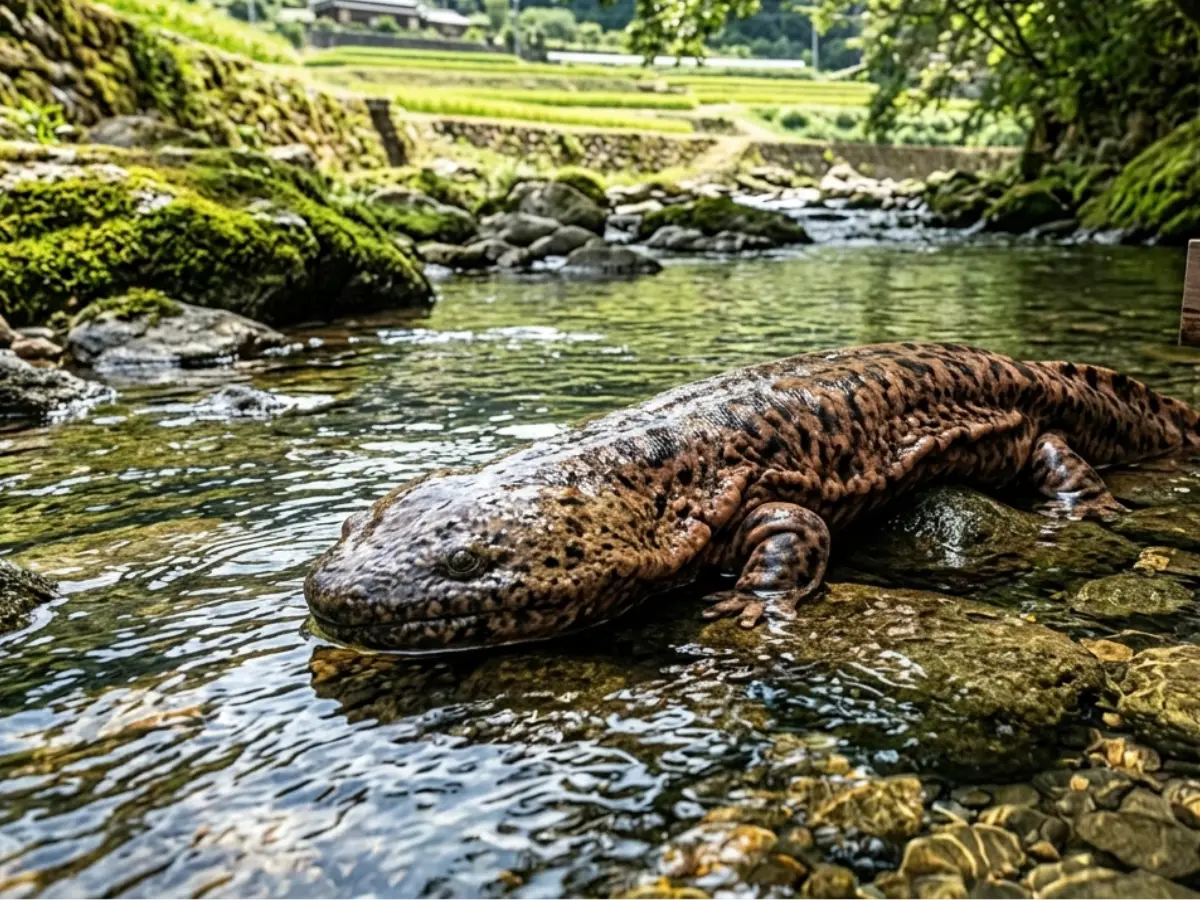
Three bones discovered between 1995 and 1997 in the Ajimu region of Japan belong to a giant salamander that scientists had never identified before. The mystery creature has been named Limnospondylus ajimuensis and lived about 3.5 million years ago in lakes. Researchers said that it measured about 3.6 feet, almost as big as some of the largest amphibians we have on Earth today. The three fossilised vertebrae were discovered nearly 30 years ago in the Tsubusugawa Formation. This region has ancient lake sediments which have previously revealed other animals, such as elephants and crocodiles, in the past. Some of the creatures found here no longer exist in Japan.
The salamander bones were initially assigned to the genus Andrias, which includes the Japanese and Chinese giant salamanders. It was only a temporary classification, as scientists did not have enough skeletal material to classify it. A team of researchers from Kyoto University decided to carry out a detailed analysis of the three bones. They used a much broader collection of modern and extinct giant salamander specimens for the study.

Giant salamander fossils in Japan
Scientists said that since the bones were found in different locations and differed in size, they were not from one animal. The fossils represented an anterior trunk vertebra, a mid-trunk vertebra, and a sacro-caudal vertebra. The revelation happened because of a mid-trunk vertebra. The feature had not been seen in the anatomy of any known member of the giant salamander family, Cryptobranchidae. This led the researchers to create an entirely new species.
Trending Stories
)
Xi Jinping's new AI bloc: China launches 'World AI Body' with Pakistan and Russia in, India out
&im=FitAndFill=(700,400))
Why the S-400 uses solid rocket fuel instead of liquid fuel
)
Explained: Why Rodri won the FIFA World Cup Golden Ball over Lionel Messi
)
Japan is selling a refrigerator to cool the human body for Rs 9 lakh. It is already a hit in Tokyo
)
Lip reader reveals what Donald Trump told every Spain and Argentina player after FIFA World Cup final during medal ceremony
)
Sonam Wangchuk's connection with George Soros and Ford Foundation explained!
)
'There is no need for...': PM Modi takes a veiled dig at Rahul Gandhi, sends big message amid Parliament March
)
FACT CHECK: Was Abhijit Dipke detained during CJP's Parliament march? Here's what police say
)
‘Netanyahu will not be arrested in any way, shape, or form in US’: Trump’s counter to Mamdani
)
UP BTech gold medalist dies by suicide after failing in nearly 50 govt job attempts, leaves note for father
)
Jail over Khamenei post: J&K youth returns home after 3 months in Saudi custody
)
'Now come to us': CJP resumes protest after Parliament march violence, calls meeting with Nadda 'waste of time'
)
Salman Khan breaks silence on health concerns after viral Mumbai appearance
)
'George Soros playbook': Understanding the foreign funding network around Sonam Wangchuk
)
Indus treaty can no longer function in its current form, says India; plans 5,500 mw of new J&K hydro projects
&im=FitAndFill=(700,400))
New OTT releases this week (July 20-26, 2026): Musafir Cafe, Adarsh Baal Vidyalaya, 72 Hours- 5 new titles coming on Netflix, Prime Video and more
&im=FitAndFill=(700,400))
2026 FIFA World Cup awards: Full list of Golden Boot, Golden Ball, Golden Glove and every major winner
&im=FitAndFill=(700,400))
FIFA World Cup 2026 team of the tournament: The best XI that ruled football’s biggest stage
)
'What is wrong...': Anna Hazare breaks silence on Sonam Wangchuk's protest, makes an appeal to Centre
)
Truck loaded with stones, metro stations closed: What's happening at Jantar Mantar now
&im=FitAndFill=(700,400))
Why US fighter jets use seamless bubble canopies compared to Russian jets
&im=FitAndFill=(700,400))
Why the F-22’s cockpit glass is thicker than a standard fighter jet
)
Student union leaders call off hunger strike at Jantar Mantar after civil society appeal, but protest continues
)
'Guru is the...': Indian Education Minister Dharmendra Pradhan shares message on education amid calls for his resignation
)
Tulsi Gabbard's brother Batarti accused of luring children to hotel room in Hawaii
)
'We acted immediately...': Indian PM Modi breaks silence on paper leaks as NEET protest, calls for Education Minister's resignation grows
“Ajimu contains the only site in the world where fossils of the giant salamander family and extant genera have both been found,” first author Masahiro Noda said. The team says that the discovery fills a major gap in the history of giant salamanders. The ancient amphibian lineage has been around for roughly 60 million years.
The creatures inhabited much of the Northern Hemisphere, but in Asia, their fossil record has a gap of more than 20 million years. The discovery of Limnospondylus suggests that giant salamanders were once more diverse in Asia than previously believed.

