Explainer: Patient dies due to Lassa fever in UK: What are the symptoms & how can it be prevented?

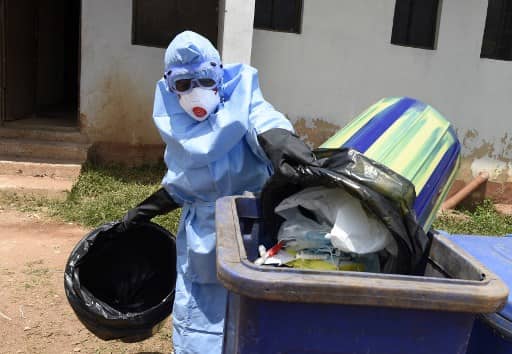
A health official at the Institute of Lassa Fever Research Hospital in Nigeria
A person suffering from Lassa fever died in Britain, UK's Health Security Agency (UKHSA) said.
UKHSA said there were three cases identified in the UK which were linked to travel to West Africa. Reports say it is the first case of the disease reported in the UK for over a decade.
The patient died in UK's Luton and Dunstable hospital.

What is Lassa fever?
According to the World Health Organisation(WHO), Lassa fever is an acute viral haemorrhagic illness caused by Lassa virus. The virus belongs to arenavirus family of viruses.
Also Read:Child in Los Angeles detected with 'flurona'; what are the symptoms?
)
Xi Jinping's new AI bloc: China launches 'World AI Body' with Pakistan and Russia in, India out
)
3.5-million-year-old mystery creature found in Japan is a 'giant' never seen before
&im=FitAndFill=(700,400))
Meet top 5 batters with most runs in India vs Zimbabwe T20Is
)
Japan is selling a refrigerator to cool the human body for Rs 9 lakh. It is already a hit in Tokyo
)
Sonam Wangchuk's connection with George Soros and Ford Foundation explained!
)
'There is no need for...': PM Modi takes a veiled dig at Rahul Gandhi, sends big message amid Parliament March
)
Iran strikes Amazon data infrastructure in Bahrain, power, water desalination plants in Kuwait
)
FACT CHECK: Was Abhijit Dipke detained during CJP's Parliament march? Here's what police say
)
UP BTech gold medalist dies by suicide after failing in nearly 50 govt job attempts, leaves note for father
)
Jail over Khamenei post: J&K youth returns home after 3 months in Saudi custody
)
'Now come to us': CJP resumes protest after Parliament march violence, calls meeting with Nadda 'waste of time'
)
Salman Khan breaks silence on health concerns after viral Mumbai appearance
)
'George Soros playbook': Understanding the foreign funding network around Sonam Wangchuk
)
Indus treaty can no longer function in its current form, says India; plans 5,500 mw of new J&K hydro projects
&im=FitAndFill=(700,400))
New OTT releases this week (July 20-26, 2026): Musafir Cafe, Adarsh Baal Vidyalaya, 72 Hours- 5 new titles coming on Netflix, Prime Video and more
&im=FitAndFill=(700,400))
2026 FIFA World Cup awards: Full list of Golden Boot, Golden Ball, Golden Glove and every major winner
&im=FitAndFill=(700,400))
FIFA World Cup 2026 team of the tournament: The best XI that ruled football’s biggest stage
)
'What is wrong...': Anna Hazare breaks silence on Sonam Wangchuk's protest, makes an appeal to Centre
)
Truck loaded with stones, metro stations closed: What's happening at Jantar Mantar now
&im=FitAndFill=(700,400))
Why US fighter jets use seamless bubble canopies compared to Russian jets
&im=FitAndFill=(700,400))
Why the F-22’s cockpit glass is thicker than a standard fighter jet
)
Student union leaders call off hunger strike at Jantar Mantar after civil society appeal, but protest continues
)
'Guru is the...': Indian Education Minister Dharmendra Pradhan shares message on education amid calls for his resignation
)
'We acted immediately...': Indian PM Modi breaks silence on paper leaks as NEET protest, calls for Education Minister's resignation grows
The UN health body says humans get infected with the Lassa virus through exposure to food items contaminated with urine or faeces of infected Mastomys rats.
Where is it found?
Lassa fever is known to be largely found in Africa. It is mainly found in Togo, Nigeria, Mali, Sierra Leone Benin, Ghana and Guinea.
How do humans get infected?
According to the UN, person-to-person infection including laboratory transmission can infect a person especially in areas where there is a lack of adequate infection prevention measures. Quick diagnosis is essential to combat the fewer in the early stages.
What is the death rate among humans?
The case fatality among humans is reportedly at 1 per cent. However, the UN body says those infected with severe cases of Lassa fever the fatality rate could be around 15 per cent.
What are the symptoms?
The symptoms occur gradually with fever, weakness and after a few days, a person suffers from headache, sore throat, chest pain and muscle pain. A person may also vomit and suffer from cough, abdominal pain and diarrhoea.
In severe cases, a patient suffers from bleeding from the mouth, low blood pressure, fluid in the lung with shock, tremor and disorientation witnessedin the later stages of the disease.
WHO says Lassa fever is difficult to distinguish from Ebola, malaria, shigellosis, typhoid fever and yellow fever.
Is there a vaccine for Lassa fever?
Currently, there is no licensed vaccine for the disease although several are in development stages. Antiviral drug ribavirin has been used in several countries as a therapeutic agent. However, the WHO has cautioned that there is no evidence to suggest that ribavirin can treat Lassa fever.
How canLassa feverbe prevented?
Good community health guidelines should be followed to discourage rodents from entering the house with effective measures to be undertaken for rodent-proof containers and disposing of garbage far away from the home.
(With inputs from Agencies)